How to get from Naples to Positano: ferry, bus or car compared
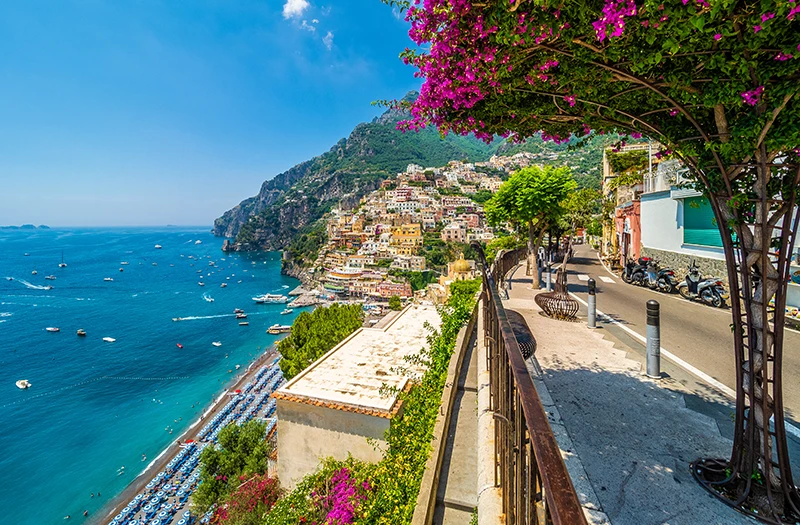
Naples and Positano are just 60 kilometres apart, but the way you choose to cover them can completely change the first day of your holiday. On one side there’s the Amalfi Coast road, as spectacular as it is narrow and busy, with bends overlooking sheer drops to the sea and summer queues that can double your journey time. On the other there’s the sea, which in just over an hour takes you straight to Positano’s Spiaggia Grande, with no changes and no parking to hunt for.
In this guide we compare every option with hard facts: real journey times, approximate costs, departure and arrival points, and the pros and cons of each. Follow our tips to reach the Amalfi Coast stress-free and start your holiday the right way.
The short answer
The direct Naples → Positano ferry takes 70 minutes and docks at Spiaggia Grande.
At a glance: what’s best
Four ways to travel, four very different experiences. Before going into detail, here’s the comparison at a glance: journey time, starting price and the detail that makes the difference.
| Transport | Duration | From | Notes |
|---|---|---|---|
| Direct ferry | 1h 10m | €29 | Lands at Spiaggia Grande in Positano |
| Bus + SITA | 2h 30m | €12 | One change in Sorrento |
| Rental car | 1h 45m + | approx. €30 | Limited, paid parking |
| Private transfer | 1h 45m + | approx. €130 | Door to door, luggage included |
By ferry: 70 minutes from Molo Beverello
The Naples – Positano route is one of the most popular with our passengers, and for good reason. It’s a direct connection with a reliable journey time, unaffected by traffic or queues on the road: you know exactly when you’ll arrive before you even set off. During the crossing, the journey becomes part of the holiday: Vesuvius behind you, the Sorrento peninsula, Capri on the horizon, and then the Amalfi Coast opening up ahead of you all the way into the bay of Positano, one of the most beautiful views in Italy. You disembark in the heart of the village, just a few steps from Spiaggia Grande.
Sailings run from April to October, with morning and late-afternoon departures. Buy online to skip the wait at the pier and secure your seat on peak-season days.

Direct trip: Naples to Positano in 70 minutes
By bus: Curreri and SITA
It’s the cheapest option, but also the longest. From Capodichino airport you take the Curreri bus to Sorrento, then continue on the SITA bus to Positano, along a narrow, winding coastal road that often gets slow and crowded in the peak months. If you have a check-in time or a return journey to make, allow plenty of extra time.
By car or private transfer
A rental car gives you freedom over your schedule, but the road to Positano is narrow and full of hairpin bends above sheer drops to the sea: a route suited only to experienced drivers, especially in the summer months when traffic is heavy. And once you arrive, you’ll have to deal with parking: there’s very little of it, almost all private and very expensive.
A private transfer has the advantage of comfort: the driver picks you up at the airport, station or hotel and drops you right at your destination, with no need to get behind the wheel yourself. However, it’s expensive and traffic is still an issue: even with a driver, it takes at least 2 hours to reach Positano.
Which to choose for your trip
For most travellers the best choice is the ferry. Whether you’re arriving on the day, have a flight to catch or simply want to start your holiday stress-free, it’s the only option that guarantees a reliable arrival time, no queues and landing right in the heart of Positano, with the added bonus of a scenic crossing along the Amalfi Coast. The bus is only an alternative if you’re on a very tight budget and have no time constraints. A car, on the other hand, only makes sense in one case: if Positano is a stop on a longer itinerary and you’ve already booked a parking space.
Want to skip the coast road traffic?
Naples → Positano in 70 minutes with Positano Jet, with hand luggage included and an e-ticket.
Tips before you go
Get to the pier 20 minutes early, bring a light layer for the open deck and check the marine forecast the day before: in rough seas, sailings may change.